 Aiman
Best Back Exercises, Ranked by EMG Not Opinion

Ask Jeff Nippard, Jeff Cavaliere, Dr. Mike Israetel, and a dozen other people who make a living ranking exercises where the lat pulldown belongs, and you’ll get an S-tier, a worst-tier, an A-tier “just below the goat of goats,” and everything in between. That’s not unusual for fitness YouTube. What’s unusual is that a lot of these disagreements are actually settleable, because people have been sticking electrodes into these exact muscles during these exact exercises since at least 1992.
So this is an attempt to do both at once: pull the actual claims out of 18 back-exercise ranking videos, then check each one against the primary EMG literature instead of the secondhand version of it that gets passed around in comment sections. Some claims hold up exactly. A couple of “everyone knows this” facts turn out to be corrections of an older, smaller study that most people citing them have never read. And in at least one case, an EMG YouTuber ran their own experiment and got a result their own audience didn’t predict — for a reason the academic literature explains, but almost nobody watching would have known about.
The ranking
In plain words: Below is a list of the best back exercises for each muscle. Each exercise gets a score from two things: what expert lifters say, and what science says. If the two don’t agree, or there isn’t much proof either way, the exercise gets a warning flag instead of a fake confident number.
Here’s the actual numbered ranking, split into the seven muscle-target groups from the full index further down (a single 1-through-92 list would force “best rear delt isolation” and “best lat width move” onto the same scale, which isn’t a fair fight). Methodology: every exercise gets a Creator Score (0-10, converting each tier verdict — S=10, A=8, B=6, C=4, D=2, F/P=0 — and averaging across every creator who rated it) and an EMG Score (0-10, scaled against the strongest number recorded for that muscle in that category). Missing data is scored as N/A, not zero — an exercise nobody’s studied isn’t penalized for the silence. The final number is the average of whichever scores exist, multiplied by a confidence multiplier (as low as 0.5) for small samples, single-study-only findings, or creator verdicts that split by more than 4 points — those get an explicit ⚠ disputed tag rather than having their disagreement quietly averaged away. Ties share a rank. Two entries that are really the same movement with different equipment (inverted row and its suspension-trainer version) are scored separately but land next to each other, as they should.
This is a transparent, argue-with-it scoring pass over the same data in the full index below, not a new measurement — the receipts for every number here are in that table.
Vertical pulls (lat width)
- Weighted pull-up
- Front lat pulldown, pronated, medium grip
- Wide-grip lat pulldown
- Strict bodyweight pull-up
- Neutral-grip lat pulldown
- Neutral-grip pull-up
- Machine-assisted pull-up
- Underhand/supinated lat pulldown
- Chin-up (underhand)
- V-bar lat pulldown
- Single-arm standing cable pulldown
- Wide-grip / behind-the-neck pull-up
- Behind-the-neck lat pulldown
- Cross-body lat pulldown
- Plate-loaded lever pulldown machine
- Band-assisted pull-up
- Kneeling single-arm lat pulldown ⚠ disputed
- Rocking lat pulldown
- Lying single-arm lat pulldown
Horizontal pulls (thickness + lat)
- Chest-supported T-bar row
- Inverted row
- Suspension/TRX inverted row
- Lat-focus row
- Chest-supported machine row
- Seated cable row
- Wide-bar seated row
- Barbell bent-over row, standard
- Cable flexion row
- Prone barbell row, upper-half ROM specifically
- Deficit Smith machine row
- Barbell row, "flexion-row" technique
- Croc row
- Tripod row
- One-arm cable row
- Bench-supported dumbbell row
- Deficit Pendlay row
- Freestanding T-bar row
- Head-supported barbell row
- Smith machine bent-over row
- Dumbbell bent-over row (both arms)
- Kneeling single-arm low row
- Unilateral high cable row
- Cambered-bar seal row
- Pendlay row
- Barbell seal row ⚠ disputed
- Yates row ⚠ disputed
- Single-arm landmine row
- Incline dumbbell row
- Improvised bodyweight inverted row
- Meadows row ⚠ disputed
- Single-arm dumbbell row ⚠ disputed
- Renegade row
Pullover / straight-arm isolation
- Straight-arm pulldown / straight-arm pushdown
- Cable pullover / "lat prayer"
- Dumbbell pullover
- Barbell pullover
- Machine pullover
- Human/bodyweight pullover
- Conventional vs. straight-arm vs. bent-arm pullover
Shrug / upper trap
- Seated dumbbell shrug
- Standing dumbbell shrug
- Unilateral (single-arm) shrug
- Standing barbell shrug
- Farmer's walk
Rear delt / rotator cuff
- Reverse pec deck
- Prone horizontal abduction + external rotation
- Cable reverse/crossover fly, neutral grip
- Side-lying external rotation
- Lying/seated rope face pull
- Standing rope face pull
- Crossover high pull
- Cable reverse fly, pronated grip
- Dumbbell reverse fly
- Standing external rotation at 0° abduction
Scapular stability / lower trap
- I-Y-T raise
- Prone arm raise overhead
- Diagonal exercise (D2 pattern)
- Prone Y raise, incline bench
- Scapular pull-up
- Scaption
- Push-up with a plus
- Press-up
- Prone Y raise with scapular-depression cueing
Deadlift / erector spinae
- Conventional deadlift
- Sumo deadlift
- Hex/trap-bar deadlift
- Jefferson-curl-style deadlift
- Deep deficit deadlift with intentional back-rounding
- Romanian deadlift (RDL)
- Good morning
- Back extension / 45° hyperextension machine
- Rack pull / block pull
First, a confession about “18 creators”
Before any of the findings: 18 videos is not 18 independent opinions. Jeff Nippard appears twice. Jeremy Ethier’s Built With Science appears four times. Dr. Mike Israetel appears three times, once solo, once on his personal channel, once in conversation with researcher Milo Wolf. Strip out the repeats and you’re left with 11 distinct voices, several of whom clearly watch and react to each other (Coach Greg’s video is a direct, exercise-by-exercise reply to Nippard’s). Worth knowing before treating “18 people agree” as more independent confirmation than it is.
That pattern isn’t unique to video, either. Nippard’s tier-list video is also the single most-reported ranking in the written fitness press — BarBend, BOXROX, Fitness Volt, and Generation Iron all published their own write-ups of the same video. Fetching and cross-checking all four against each other turns up solid agreement on the big calls (pulldowns and cable/chest-supported rows land at the top everywhere, the deadlift lands in C, renegade rows and combination dumbbell rows land in F) and real disagreement on the fine-grained ones — exactly which tier a wide-grip pull-up or chin-up belongs in shifts from outlet to outlet. Four publications summarizing the same 30-minute video couldn’t converge on that detail. “Multiple sources agree” can still just mean multiple people paraphrasing the same original imprecisely, in print as much as on YouTube.
A later research pass also pulled roughly 25 more general “how to train your back” videos (including several more from Dr. Mike Israetel and one Jeff Nippard collaboration), specifically to check for anything the 18 tier-list videos above missed. None of it contained citable academic data or exercise-ranking verdicts beyond what’s already covered here, so none of it is cited directly. The one exception, Ryan Humiston’s self-tested EMG numbers, gets its own section below.
Grip width: it depends which exercise you’re asking about
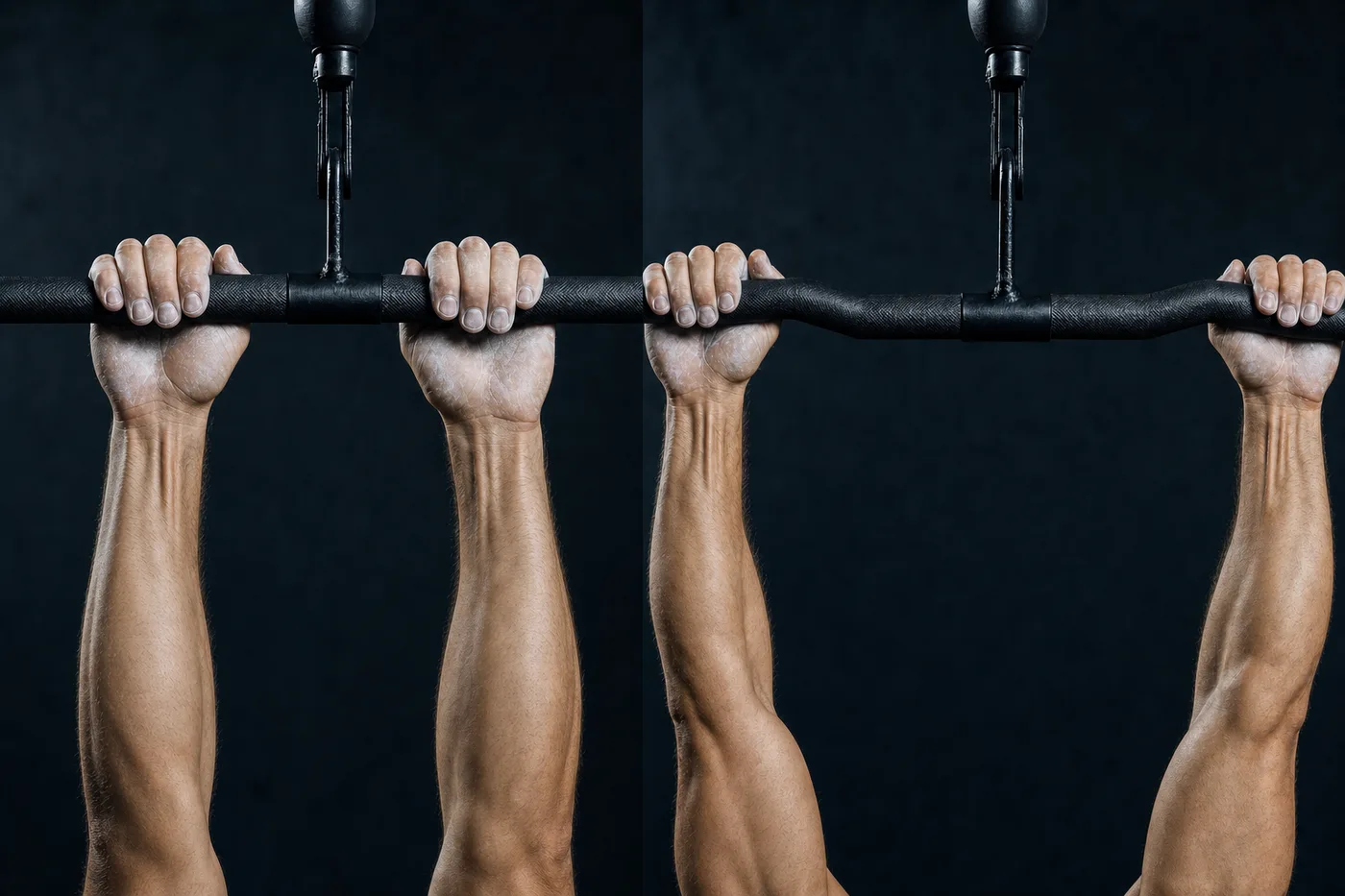
In plain words: Using a wide grip or narrow grip on pull-downs and pull-ups does not change how hard your back works. Five studies agree on this. What actually matters is turning your palms down. For rows, though, grip width might really matter — and even the scientists don’t fully agree on that one yet.
This is the single most repeated claim across the whole dataset, and it’s a case where the popular version is a myth that’s already been corrected once — most people just cite the pre-correction study.
For vertical pulling (lat pulldowns, pull-ups), five independent studies spanning two decades and different labs all land on the same null result for width: Lehman 2004 (n=12), Lusk 2010 (n=12), Andersen 2014 (n=15), Buonsenso 2025 (n=40, seven grip variants), and Dickie 2017 (n=19, pull-ups). Narrow, medium, and wide grip all produce statistically indistinguishable lat dorsi activation. What actually moves the needle: pronation. Lusk 2010 found pronated grip beat supinated for lat activation (p=0.012) while width made no difference at all (p=0.711). Andersen 2014 went further and found going wide didn’t just fail to help — it cost lifters about 4% of their 6RM load (p=0.02) for zero EMG benefit, purely from the worse leverage.
The myth this corrects is Signorile et al. 2002 (n=10), the study that’s still floating around as “proof” wide grip builds a wider back. Signorile did find wide-grip-anterior beat everything else — but the “wide” and “anterior” variables were tangled together in that design. Once later studies isolated width from bar path, the width effect disappeared and only the path/pronation effects survived.
Even the written fitness press can’t agree on which direction this myth runs. T-Nation’s own coaching literature argues the reverse of the popular claim — a closer, shoulder-width grip targets the lats specifically, while a wider grip is better suited to the upper back on chins and pulldowns — while equipment-brand buying guides (Major Fitness and others) argue the standard version, wide grip for lat width and narrow for thickness. Neither cites a study. Both are describing the same movement the five null-result studies above already settled, in opposite directions.
Here’s the part almost none of the 18 videos get right, because it requires reading past the pulldown literature into the separate row literature: for rows, grip width might actually matter, just not for the reason “wide = width, narrow = thickness” folklore usually gives. Padovan & Coratella (2025, HD-EMG, n=14) found narrow-grip seated rows produced higher lat dorsi activation (ES=1.08 across both phases) while wide-grip rows produced higher upper trap (ES up to 2.79), middle trap, and lateral deltoid activation. That’s specific, real, and it’s exactly what Jonni Shreve (one of the 18 creators) says from pure gym experience — wide-bar seated rows are “more of a rear delt exercise… with some lats” — and what Built With Science’s Kassem Hansen collaboration argues when it tells people to use a narrow, neutral grip specifically to target the lower lats.
But it’s not settled. Taboada-Iglesias et al. (2024, n=12) tested nine grip combinations on a cable row and found lat dorsi activation was statistically identical across all of them (63-73% MVIC regardless of grip) — only biceps, posterior deltoid, and trapezius shifted with grip. Same exercise family, same basic question, two well-designed studies, two different answers. That’s not a YouTuber disagreement. That’s the actual literature disagreeing with itself, and it’s worth saying plainly instead of picking whichever result is more satisfying.
One creator’s DIY EMG numbers mostly agree with the literature — with one real gap
In plain words: One YouTuber put sensors on his own arms and back to test which grips work the back muscles more than the arm muscles. Keeping your elbow tucked in and your palm facing down worked best. For pull-ups, only a wide grip made the back work harder than the arms — every other grip made the arms do more work.
Ryan Humiston is already one of the 18 creators above. His tier-list video contributes a Creator Score entry the same as everyone else’s, but the numbers below come from a separate video where he didn’t just film himself doing back exercises and offer an opinion: he strapped surface EMG sensors to his own lats and biceps, tested grip and attachment variations directly, and published the lat-to-bicep activation gap for each. That self-tested data doesn’t feed into his Creator Score above, and it’s not a peer-reviewed study either (no p-values, no third-party verification). Where it overlaps with the real literature elsewhere in this piece, it mostly agrees, and the one place it doesn’t overlap is worth noting on its own.
On one-arm rows, keeping the elbow in a fixed arcing path (instead of the “grab heavy weight, yank it up” version) took his lat-to-bicep activation gap from 34.8 percentage points to 73.5, and adding a pronated grip on top of that pushed it to 94. On lat pulldowns, his numbers ranked wide-grip pulldowns (63-point gap) and a pullover-style pulldown (71-point gap) well ahead of the V-bar and reverse-grip variations, the latter of which he found bicep-dominant enough to not recommend at all.
The one place his numbers cover something the five peer-reviewed grip-width studies above don’t: pull-ups specifically. Those studies measured whether grip width changes lat activation, and it doesn’t. Humiston measured the lat-to-bicep ratio across pull-up grips instead, a different question, and found only the wide-grip variation crossed into “more lat than bicep” territory. Every other variation he tested (reverse-grip, V-bar, fixed-elbow versions, even after pre-exhausting his own biceps for 30 minutes first) came back bicep-dominant. Nobody in the published literature gathered here has measured a lat-to-bicep activation ratio across pull-up grip variations, so this is one YouTuber’s electrodes standing in for research that doesn’t currently exist.
He also tested bent-over rows at two loads: light (20-25 reps) and heavy (8-10 reps). The heavier load produced more lat and upper-trap activation and less lower-trap (the opposite of what “go lighter to isolate the muscle” folklore usually claims), and a more upright torso angle shifted activation toward upper traps while leaning closer to parallel with the floor shifted it back toward lats. That direction of effect lines up with Fenwick et al. (2009) finding that trunk position changes a row’s muscle-activation pattern, just measured with a different device on a different day.
Behind-the-neck pulldowns: everyone’s right about the risk, nobody mentions the nuance

In plain words: Pulling the bar down behind your neck is bad for your shoulder, and it does not make your back work any harder than pulling it down in front. There is no real reason to do it. Just pull in front instead.
Jeff Cavaliere puts behind-the-neck lat pulldown at the very top of his worst-exercises list, citing internal rotation of an overhead, loaded shoulder as an impingement risk. Jeff Nippard and Straight Up Strength both steer people toward front pulldowns for the same reason. This holds up against the data in two separate ways: Signorile 2002 found lifters used about 6-7% less average 10RM load on behind-the-neck versus other grips (a real mechanical disadvantage, not just a safety concern), and Sperandei 2009 (n=24) found behind-the-neck produced no extra lat activation at all (p=0.777 across all three grips tested) while recruiting more pectoralis, posterior deltoid, and biceps — exactly the muscles you don’t want compensating on an overhead pull.
What none of the 18 mention: Coratella et al. (2024, HD-EMG, n=14) found the front-vs-behind-neck question is actually phase-dependent. Front pulldown wins the concentric (pulling) phase (ES=0.97), but behind-the-neck wins the eccentric (lowering) phase (ES=0.63). It’s a genuinely interesting finding that changes nothing about the practical advice, since the injury-risk argument for skipping behind-the-neck pulldowns stands regardless of which phase technically activates the lats slightly more. It’s a good example of an academic nuance that’s real but doesn’t clear the bar to actually change what you should do in the gym.
Is the deadlift even a back exercise?
In plain words: The deadlift makes your whole back work hard, but scientists have barely studied whether that work actually builds your back muscles. It is a great exercise overall. It just might not be the smartest pick if a bigger back is your only goal.
This is where the creators split hardest. Dr. Mike Israetel gives it “A for raw stimulus, C for stimulus-to-fatigue” — a genuinely useful distinction he draws explicitly: the deadlift trains your whole posterior chain hard, but almost none of that cost buys you back-specific growth, because your hamstrings, glutes, and adductors fail long before your lats do. Jeff Nippard gives it a flat C, citing the total absence of stretch at the bottom of the lift. One unnamed tier-list creator puts it in D, arguing “this myth that the deadlift is a must-do exercise to build muscle needs to die.” Straight Up Strength, ironically, ranks it B — “it doesn’t check all the boxes.”
Outside the 18 videos, the flattest version of this argument is made in writing. The Brookbush Institute, a continuing-education provider for physical therapists, argues that deadlifts are “a poor choice for back muscle hypertrophy” because the back muscles work mostly isometrically during the lift, and cites research putting the latissimus dorsi’s own contribution to lumbar extension at roughly 6.3 newtons — 20% or less of what the erector spinae contributes. That’s a harder stance than any of the 18 videos take, including the unnamed creator’s D tier.
Then Built With Science ran an actual EMG test — four subjects, real electrodes, a machine they call “Betty” — expecting deadlifts to underperform for the back, based on how their own audience voted in a prediction poll. Instead, deadlifts showed unexpectedly high activation across every back muscle they measured, for all four subjects, including a complete beginner and someone using a much lighter, elevated-platform variation.
Here’s the context that explains why nobody saw that coming: Martín-Fuentes et al.’s 2020 systematic review pooled 19 separate deadlift EMG studies, and found that only one of them ever measured lat dorsi at all (an isometric-only study). The deadlift EMG literature is almost entirely about erector spinae, glutes, hamstrings, and quads — the muscles everyone already assumed mattered. Built With Science’s back-specific test is one of the only direct measurements of what a deadlift does to your lats and traps that exists anywhere, academic papers included. It’s not that the internet got this one wrong; it’s that almost nobody, including the researchers, had actually checked.
None of that resolves the tier-list argument, and it shouldn’t — high activation from isometric stabilization under enormous whole-body fatigue is a real training effect, but “your back worked hard” and “this is an efficient way to grow your back specifically” are different claims. Israetel’s stimulus-to-fatigue framing survives this data even without a single dedicated lat-EMG deadlift study behind it.
Coaching cues aren’t a placebo

In plain words: Telling someone exactly how to feel a muscle while they lift really does help. In one study, coaching plus a light touch on the muscle made it work much harder, without making the arm muscles work harder too. Good coaching cues are not just talk.
Nearly every one of the 18 creators has a personal cue for “actually feeling your lats” — pull with your elbows not your hands, shove your shoulder down, palpate the muscle, imagine punching yourself in the face. It’s the most repeated piece of advice in the entire dataset, from Dr. Mike’s RP video to Built With Science’s Kassem Hansen collaboration to Jeff Nippard’s own coaching recommendations.
Snyder & Leech (2009) tested this directly on 8 untrained women doing lat pulldowns. After specific verbal coaching plus manual palpation of the lat, peak isometric LD activation jumped from 71.1% to 83.59% (p=0.005) — a real, measurable, non-trivial increase. Crucially, biceps activation barely moved (30.45% to 31.36%, not significant), meaning the cueing didn’t just make people pull harder overall, it specifically redirected effort toward the target muscle without dragging the synergist along for the ride.
The pullover isn’t actually the best lat stretch

In plain words: Everyone says the pullover is the best exercise to stretch your back muscles. A real study found something different: the pullover mostly works your belly muscles and chest, not your back. A different move, the straight-arm pulldown, works your back more.
Here’s the cleanest case of “the internet is confidently repeating a vibe that the data contradicts.” Dr. Mike Israetel calls the cable pullover his “lat prayer” and rates it S-tier. Jeff Nippard gives the cable lat pullover A-tier. Straight Up Strength calls the dumbbell pullover a staple. Across the dataset, the pullover is treated as the definitive deep-stretch lat isolation move.
Muyor et al. (2022, n=20) directly compared barbell pullover against straight-arm pulldown at two loads, measuring EMG across the whole upper body (F(4.03,76.65)=26.06, p<0.001). The pullover won on almost every muscle measured — except the two that mattered most for the “best lat exercise” claim. Lat dorsi activation: pullover ≈7% MVIC, straight-arm pulldown at 100% bodyweight-equivalent load ≈17%, at 150% load ≈19%. The pullover’s standout muscle wasn’t the lats at all — it was rectus abdominis, at ≈18% MVIC, almost certainly because holding the lumbar spine stable during that big overhead arc is itself a real core-stabilization task. Marchetti & Uchida (2011, n=8) independently confirmed the same basic pattern with a barbell pullover at 30% bodyweight: pectoralis major outworked latissimus dorsi.
None of this means skip the pullover. It means it’s doing something real, just probably not the specific job most people are assigning it. If the actual goal is maximum lat stretch under load, the straight-arm pulldown is the better-supported choice; if the goal is a lat-adjacent core and pec stimulus with a nice stretch feel, the pullover is doing exactly what the EMG says it does.
Inverted row vs. bent-over row: a trade-off nobody puts a number on
In plain words: The bent-over row and the inverted row work your back about the same amount. But the bent-over row puts about 50% more strain on your lower back to get there. Neither one is simply “better” — you are trading safety for how much weight you can lift.
Several creators treat the inverted row as either underrated (Dr. Mike Israetel: “I want to believe in it more than I’m led to”) or a beginner-only stepping stone (most others). Fenwick, Brown & McGill (2009, n=7) measured exactly what’s being traded off, and it’s more specific than “one is easier.”
Bent-over barbell row and inverted row produced broadly comparable back-muscle activation, but bent-over row loaded the lower back dramatically more: lumbar erector spinae activation of 42.5-43.3% versus 28.7-29.9% for inverted row (p=0.0004 to p<0.0001), and L4/L5 spinal compression of 3576N versus 2339N for inverted row and 2457N for cable row (p<0.0001). That’s not a small difference — it’s roughly 50% more compressive load on the lower spine for a row variation that doesn’t clearly out-activate the back muscles you’re actually trying to grow.
This also explains something that looked like a fluke: when Built With Science ran their own EMG “Betty” experiment across 17 back exercises, the inverted row won outright for their beginner and their female subject, but lost for the two more experienced lifters. That’s consistent with the Fenwick data — inverted row has a lower, harder-capped ceiling on load, which matters less for someone who’s nowhere near that ceiling and matters a lot for someone who’s already strong enough to load a bent-over row heavy. Neither exercise is simply better; they cap out at different points, at different costs to the lower back.
Rear delts want their own exercise, not a row
In plain words: Rows and pull-downs barely train your rear shoulder muscles. A move made just for that muscle, like a reverse pec-deck fly, works it way harder. If you want bigger rear delts, don’t count on your rows to do it for you.
This is one of the cleaner points of full agreement between the creators and the literature, though it takes assembling three separate studies to see the whole picture. Botton et al. (2013, n=12) found reverse pec deck produced roughly 90% MVIC in the posterior deltoid, dramatically ahead of incline pulldown (~58%) and seated row (~54%, both p<0.05). Reinold et al. (2004) — using intramuscular fine-wire electrodes, the highest-precision method in this entire dataset — found posterior deltoid, supraspinatus, and middle deltoid all peaked during prone horizontal abduction with external rotation (82-88% MVIC), while infraspinatus and teres minor specifically preferred side-lying external rotation (62-67% MVIC). And Schoenfeld et al. (2013, n=19) found grip matters for rear-delt isolation work specifically: neutral grip beat pronated for both posterior deltoid (small effect) and infraspinatus (moderate effect, p=0.002).
Put together: rows and pulldowns give the rear delts a moderate, incidental training effect at best. If rear delt or rotator cuff development is an actual goal rather than a side effect, it needs its own dedicated, isolated movement — which is exactly what Dr. Mike Israetel and TNF land on by feel in their own two-exercises-per-muscle video, independently landing on a neutral-grip crossbody cable fly for the same reason the EMG suggests.
The complete index: every exercise these 18 videos and 29 studies actually named
The sections above pull out the handful of stories worth telling in full. But 18 full-length ranking videos plus dozens of EMG papers name a lot more exercises than that — roughly 90 distinct named variants once you count every grip, setup, and equipment substitution separately. Collapsing all of that into six sections would have quietly thrown most of it away. Here’s the rest, grouped by what they’re actually trying to train, each with where it landed across sources and whatever EMG data exists for it specifically.
Vertical pulls (lat width)
| Exercise | Where it lands | Note |
|---|---|---|
| Weighted pull-up | Top tier almost everywhere (Cavaliere, Straight Up Strength, Nippard, Israetel, Dr. Mike RP) | Youdas 2010: 117-130% MVIC lat activation — highest number in the entire dataset |
| Strict bodyweight pull-up | Top tier | Straight Up Strength: goal for every lifter is 10 unbroken reps before adding load |
| Chin-up (underhand) | B for pure back (more bicep/pec) | Doma 2013 + Youdas 2010: more biceps/erector spinae than pulldown/pull-up equivalents |
| Neutral-grip pull-up | A across the board | No creator disagreement found |
| Wide-grip / behind-the-neck pull-up | B, “look cooler than they are” (Straight Up Strength) | No dedicated EMG isolating this from other pull-up variants |
| Band-assisted pull-up | C (Israetel: “force curve backwards”) | — |
| Machine-assisted pull-up | B-S depending on machine | Recommended default for anyone who can’t yet do a bodyweight rep |
| Front lat pulldown, pronated, medium grip | S almost everywhere | Coratella 2024: concentric-phase lat ES=0.97 vs behind-neck |
| Behind-the-neck lat pulldown | Worst tier (Cavaliere), avoided by most | Sperandei 2009: no EMG advantage (p=0.777), more pec/delt/biceps recruitment, more injury risk. Coratella 2024: does win the eccentric phase specifically (ES=0.63) — a real nuance nobody acts on |
| Wide-grip lat pulldown | S (Nippard) | Buonsenso 2025 (n=40): no different from other widths |
| Neutral-grip lat pulldown | S, “slightly more lat emphasis” (Nippard) | — |
| Underhand/supinated lat pulldown | B, more biceps involvement | Lusk 2010: supinated measurably lower lat EMG than pronated (p=0.012) |
| V-bar lat pulldown | Personal favorite (Dr. Mike RP), recommended for lower lats (Built With Science/Kassem Hansen) | — |
| Cross-body lat pulldown (kneeling, torso twisted 90°) | A (Nippard) / B (“awkward, takes twice as long” — Coach Greg) | — |
| Kneeling single-arm lat pulldown | S-tier “heralded as optimal” (Nippard) vs P-tier “pencil neck” (Straight Up Strength) | Genuinely unresolved — no EMG study in this dataset isolates single-arm vs bilateral pulldown directly |
| Plate-loaded lever pulldown machine | B (Israetel: “feels like assisted pull-up”) | — |
| Lying single-arm lat pulldown (face-down on floor) | P-tier, “silly,” “dirty gym floor” (Straight Up Strength) | — |
| Single-arm standing cable pulldown | Recommended for lower lats specifically (Built With Science/Kassem Hansen) | — |
| Rocking lat pulldown (intentional side-to-side bias) | Niche technique suggestion (Cavaliere), no tier given | — |
Horizontal pulls (thickness + lat)
| Exercise | Where it lands | Note |
|---|---|---|
| Barbell bent-over row, standard | High tier nearly everywhere, always caveated | Fenwick 2009: highest L4/L5 compression of any row tested (3576N, p<0.0001) |
| Barbell row, “flexion-row” technique (round back at bottom, rise onto toes at top) | A, Israetel’s specific recommended technique | — |
| Pendlay row | B (Nippard) / C, “harder on the lower back” (Coach Greg) | — |
| Deficit Pendlay row | A (Nippard) / still C (Coach Greg) | — |
| Yates row | “Goated”/S (Straight Up Strength) vs C, “reduces stretch, more momentum” (Nippard, Coach Greg) | Signorile-style bar-path logic would predict less stretch; no direct EMG on this specific variant |
| Dumbbell bent-over row (both arms) | B, “comfortable” (Israetel) | — |
| Single-arm dumbbell row (bench-braced) | A (Nippard, “done it a decade without issue”) vs avoided entirely for hernia risk (Cavaliere) vs D (Straight Up Strength) | No EMG study in this dataset tests the injury claim either way. Ekstrom 2003 (n=30) tested a one-arm row for trapezius specifically and found it only moderate — 63% upper, 79% middle, 45% lower trap MVIC — well behind dedicated shrug/prone-raise/extension work for that muscle, whatever the verdict on lats |
| Croc row (single-arm dumbbell, leg-drive/momentum) | A, “leans into the natural strength curve” (Nippard) | — |
| Meadows row | Split hard: Almost Best (Cavaliere), S (Nippard) vs “pencil neck,” overrated (Straight Up Strength) vs C (Coach Greg) | — |
| Freestanding T-bar row | B, “epic looking… annoying, balance issue” (Nippard) | — |
| Chest-supported T-bar row | Near-universal A/S | — |
| Single-arm landmine row | Moderate — “limiting factor” (Jonni Shreve); D if it’s your only option (Israetel, per Torque-style setup) | — |
| Seated cable row (V-bar/D-handle/straight bar/wide bar) | Near-universal S/A | Taboada-Iglesias 2024 (n=12): grip doesn’t change lat EMG. Padovan/Coratella 2025 (n=14, HD-EMG): grip does. The two studies disagree with each other, not just the YouTubers |
| Wide-bar seated row specifically | “More rear delt than lats” (Jonni Shreve) | Padovan/Coratella 2025 backs this quantitatively (wide grip → higher trap/rear delt ES) |
| Cable flexion row (deep spinal flexion/extension setup) | Personal favorite, near-S (Dr. Mike RP; also praised by Israetel/Milo Wolf) | Trains spinal erectors through active ROM, unlike the isometric-only erector work in a deadlift |
| Chest-supported machine row (quality-dependent) | Near-universal A | Israetel: machine fit varies wildly by lifter height — “some machines just don’t fit anyone under 6 feet” |
| Bench-supported dumbbell row (incline bench brace) | A/B | — |
| Incline dumbbell row (angled bench, single-arm) | C, “nasty force-curve problem, hardest at the top” (Israetel) | — |
| Smith machine bent-over row | B, “safer than free weight” (Jonni Shreve) | — |
| Deficit Smith machine row (standing on plates) | A | — |
| Inverted row | Split by experience level — great for beginners, caps out fast for advanced lifters | Snarr & Esco 2013: ~99-101% MVC lat activation, one of the highest numbers in the whole dataset. Fenwick 2009: lowest L4/L5 load of any row tested |
| Suspension/TRX inverted row | Same tier as regular inverted row | Snarr & Esco 2013: no significant difference from a fixed bar — the “instability = more muscle” marketing claim isn’t supported here |
| Improvised bodyweight inverted row (PVC pipe/broom between chairs) | C, “serviceable” home-gym substitute | — |
| Renegade row | F/P everywhere — the one full unanimous rejection in the entire dataset | — |
| One-arm cable row | Moderate lat/back activation, lowest lumbar load alongside inverted row | Fenwick 2009 |
| Kneeling single-arm low row (cable, front-braced) | S, but only from the one creator who invented this specific setup | Not corroborated elsewhere |
| Unilateral high cable row, sagittal-plane setup | “Best back exercise,” top pick (Torque/TNF pairing) | Not independently validated by EMG in this dataset |
| Lat-focus row (lean-forward, elbows tucked — mimics a pulldown) | Best lat activator of everything tested in Built With Science’s own 17-exercise EMG experiment | — |
| Tripod row (both feet down, one-hand brace — fixes one-arm dumbbell row’s asymmetry) | “Better Still” tier (Cavaliere) | — |
| Bench-supported vs standing bent-over row | Bench version tentatively recommended for anyone managing lower-back load | García-Jaén 2021 (n=3, preliminary, 4-condition design): in the shoulder-abduction position specifically, bench cut lumbar erector activation roughly two-thirds versus standing (23.67% vs 70.67% MVIC) while posterior deltoid/upper trap stayed comparable — but in the adduction position the bench version wasn’t nearly as low (52.67% vs 74.67%). None of these differences reached statistical significance (all p≥0.109, n=3) — read this as a preliminary hypothesis, not a settled finding |
| Head-supported barbell row (forehead braced on a pad) | B, “gets the job done” (Straight Up Strength) | — |
| Barbell seal row (chest+face supported, prone) | Personal favorite/goated (Straight Up Strength) vs “worst-leveraged supported row I’ve tried” (Israetel) | Another genuine split verdict between experienced coaches |
| Cambered-bar seal row | Recommended upgrade to standard seal row for extra ROM | — |
| Prone barbell row, upper-half ROM specifically | Not discussed by any of the 18 creators as its own variant, but the data favors it | Fischer 2025 (n=16): lat dorsi sEMG significantly higher in upper-half (stretched-position) ROM than either full ROM or lower-half ROM (p<0.001, d≈-0.58/-0.59) — trapezius transversus shows the opposite pattern, higher in the lower-half. This lines up with a technique Built With Science recommends independently: once a full rep isn’t possible anymore, keep going with half-reps in that same top/stretched position rather than stopping — a gym habit that happens to match what Fischer’s data says is the better half of the rep for the lats specifically |
| Rows/pulldowns as an indirect biceps/elbow-flexor exercise | Not really a separate exercise, but a common justification for choosing one row over a curl | Gentil 2015 (n=29): lat pulldown alone vs. biceps curl alone produced statistically identical elbow-flexor growth (6.10% vs 5.83%). Gentil 2013 (n=29): adding curls+extensions to a multi-joint program added no extra growth over multi-joint alone (p>0.05). Mannarino 2021 (n=10): a dumbbell row still grew the elbow flexors only about half as much as a direct biceps curl (5.16% vs 11.06%, p=0.009) — a pulling exercise can substitute for isolated arm work, but it’s not an efficient way to specifically train the biceps |
Pullover / straight-arm isolation family
| Exercise | Where it lands | Note |
|---|---|---|
| Barbell pullover (lying on bench) | A, staple | Muyor 2022 / Marchetti 2011: pectoralis major activates more than lat dorsi — real exercise, not the top lat move its reputation suggests |
| Dumbbell pullover | A, staple (Nippard, Straight Up Strength) | Same caveat as barbell version |
| Cable pullover / “lat prayer” | S, personal favorite (Dr. Mike RP) | Muyor 2022’s direct comparison favors straight-arm pulldown over this for lat dorsi specifically |
| Machine pullover (rare equipment) | A “if your gym has one” (Nippard) / “on paper S-tier, in reality B-tier” (Israetel — poor fit for larger lifters) | — |
| Straight-arm pulldown / straight-arm pushdown | Near-universal A | The one Muyor 2022 data actually favors for lat isolation, ≈17-19% MVIC vs pullover’s ≈7% |
| Human/bodyweight pullover (no equipment, move body on fixed arms) | “Better Still” tier home-gym substitute (Cavaliere) | — |
| Conventional vs straight-arm vs bent-arm pullover | Bent-arm produces 46-49% more strength than conventional | Washif 2024 (n=7 javelin throwers): no significant lat dorsi EMG difference between the three variants — a strength-focused study with limited generalizability to hypertrophy in typical lifters |
Shrug / upper trap family
| Exercise | Where it lands | Note |
|---|---|---|
| Standing barbell shrug | B-A depending on execution (accelerated concentric, slow eccentric) | — |
| Standing dumbbell shrug | A/S, easier full ROM than barbell | — |
| Unilateral (single-arm) shrug | Not mentioned by any of the 18 creators — nobody ranks this as its own variant | Ekstrom 2003 (n=30): the single highest upper-trap number in this entire dataset came from a unilateral shrug, 119±23% MVIC, ahead of every bilateral shrug or row tested |
| Seated dumbbell shrug | S — independently, from both Israetel and TNF | Built-in length-partial (rep ends when dumbbells touch the bench), lower systemic fatigue than standing |
| Farmer’s walk | D for raw stimulus magnitude, A for stimulus-to-fatigue ratio — Israetel gives it both grades at once | Massive systemic/axial fatigue cost relative to the isolated trap stimulus it provides |
Rear delt / rotator cuff family
| Exercise | Where it lands | Note |
|---|---|---|
| Reverse pec deck | Clear winner for posterior deltoid | Botton 2013: ~90% MVIC vs incline pulldown (~58%) and seated row (~54%), p<0.05 |
| Cable reverse/crossover fly, neutral grip | S (TNF/Torque pairing) | Schoenfeld 2013 backs neutral over pronated for this exact muscle |
| Cable reverse fly, pronated grip | Measurably worse for infraspinatus | Schoenfeld 2013: d=0.5, p=0.002 vs neutral grip |
| Dumbbell reverse fly (lying/bent-over) | Common but flawed — loses tension exactly at peak contraction as gravity pulls the arms down | One creator built a whole alternative move specifically to fix this |
| Crossover high pull (cable, creator-invented variant) | A, personal pick from the creator who invented it | Not independently validated elsewhere |
| Standing rope face pull | B, unstable against gravity (Nippard) | — |
| Lying/seated rope face pull | Upgraded to A once the balance-fighting is removed (Nippard) | — |
| Prone horizontal abduction + external rotation | Highest of 7 rotator-cuff exercises tested for posterior delt/supraspinatus/mid-delt | Reinold 2004 (fine-wire EMG, highest precision in this dataset): 82-88% MVIC |
| Side-lying external rotation | Highest for infraspinatus/teres minor specifically — a different target than the exercise above | Reinold 2004: 62-67% MVIC |
| Standing external rotation at 0° abduction | Lowest-performing comparison exercise in that same study | Reinold 2004 |
Scapular stability / lower trap family
Almost none of the 18 creators mention this category at all — it shows up almost entirely in the academic papers.
| Exercise | Where it lands | Note |
|---|---|---|
| I-Y-T raise | Highest lower trapezius activation of 8 exercises tested — but also the single lowest lat dorsi number in the same study | Edelburg 2017 thesis (n=19, %MVC, also reported by ACE/Porcari at UW-La Crosse): lower trap 81% (highest, p<0.05 vs all 7 others). Middle trap 108% (tied highest with bent-over row, inverted row, seated row). Infraspinatus 58% (tied highest with bent-over row, chin-up, inverted row, pull-up). Lat dorsi only 39% — the lowest of all 8 exercises, well behind pull-up/chin-up’s 105-108%. A genuine trade-off, not a free lunch: great for lower trap specifically, weak for lats |
| Prone Y raise (incline bench) | Best lower-trap exercise in Built With Science’s own 17-exercise EMG test; also the specific exercise recommended in the one “science-based back workout” video that covers this muscle at all | — |
| Scapular pull-up (hang from bar, depress scapula without bending elbows) | Explicitly recommended for lower trap/scapular stability | Named directly in one science-based creator video |
| Scaption (elevation in scapular plane + external rotation) | One of a 4-exercise “core” set covering all scapular stabilizers | Moseley 1992 |
| Prone arm raise overhead (scaption-family variant) | Best exercise for middle and lower trapezius of 10 tested — again, not named by any of the 18 creators | Ekstrom 2003 (n=30): middle trap 101±32% MVIC, lower trap 97±16% MVIC, both the highest of everything in that study |
| Diagonal exercise (D2 pattern: shoulder flexion + horizontal flexion + external rotation) | Best of 10 exercises tested for serratus anterior, a muscle none of the 18 creators mention at all | Ekstrom 2003: 100±24% MVIC, tied with abduction past 120° in the scapular plane (96±24%) |
| Push-up with a plus (extra protraction at the top) | Second of that same core-4 set | Moseley 1992 |
| Press-up | Fourth of that same core-4 set (rowing is the third — covered above) | Moseley 1992 |
| Prone Y raise with intentional scapular-depression cueing | Cueing measurably shifts trap dominance from upper to lower/middle | Yu et al. 2025 — tested on a scapular-dyskinesis population, not healthy lifters, so generalization is limited |
Deadlift / erector spinae family
| Exercise | Where it lands | Note |
|---|---|---|
| Conventional deadlift | Highest erector spinae stimulus of anything tested | Martín-Fuentes 2020: but almost no lat-dorsi EMG data exists for it at all (1 of 19 studies reviewed) |
| Sumo deadlift | Lower thoracic erector spinae than conventional | Hanen 2025: 67.1% vs 74.8% MVC, p=0.022 — though Martín-Fuentes 2020 flags older literature (Escamilla 2002) as finding no difference at all. Conflicting results, not consensus |
| Romanian deadlift (RDL) | Erector spinae activation actually lower than biceps femoris/semitendinosus | Martín-Fuentes 2020 — opposite activation pattern from the standard deadlift |
| Hex/trap-bar deadlift | More back-friendly, less back-training | Martín-Fuentes 2020: higher quad activation, lower erector spinae than standard deadlift |
| Elevated-platform “Jefferson curl” style deadlift (minimal hip/knee movement, spine does the work) | Israetel’s specific personal recommendation, described as excellent for back resilience and hypertrophy | Anecdotal — not independently EMG-tested in this dataset |
| Deep deficit deadlift with intentional back-rounding | Same recommendation, closely related variant | Same caveat |
| Rack pull / block pull | Near-universally low tier, “ego lifting” | Below-knee block pulls get slightly more credit than above-knee across multiple creators |
| Good morning | Mentioned in passing as deadlift-adjacent by several creators | No EMG data captured for this variant in the studies gathered here |
| Back extension / 45° hyperextension machine | Low tier for anyone chasing lat width (D-tier, “myth needs to die” — one creator), but flagged as a legitimately isolated erector-spinae move by another | One creator explains the mechanism well even without EMG backing it up here: the “Christmas tree” look people chase from lower-back training actually comes from where the lats insert near the bottom of the ribcage, not from the erector spinae itself — so back extensions train a real muscle, just not the one that produces the look most people are training it for. No study in this dataset measured this specific machine directly |
| Reverse hyperextension | Not named by any of the 18 creators, but recommended repeatedly across a separate batch of technique-focused videos as a distinct alternative to the back extension | Hip-driven rather than spine-driven — the torso stays fixed and the legs swing, the opposite emphasis of a standard back extension. No EMG data found for this variant in the dataset gathered here, only creator anecdote |
The short version
Grip width is a myth for pulldowns and pull-ups (five studies agree it doesn’t matter, pronation does), but it may be real for rows — though the row literature hasn’t actually settled that argument with itself yet. Behind-the-neck pulldown deserves its bad reputation on injury-risk grounds regardless of a genuinely interesting eccentric-phase nuance nobody needs to act on. The deadlift’s back contribution is real but almost entirely unmeasured in the scientific literature outside of one YouTube EMG experiment, which is a strange gap for such a popular exercise. Coaching cues measurably work. The pullover is a great exercise for something other than what most people are using it for. Bent-over rows and inverted rows trade lower-back load for a load ceiling, not one being simply superior. Rear delts need their own movement. And once you actually list out all ~90 named variants, the pattern holds at scale too: wherever a creator claim and an EMG number cover the same exercise, they mostly agree — the real disagreements cluster in the handful of spots (single-arm pulldowns, one-arm rows, row grip width, seal rows) where either the creators split from each other or the studies split from each other.
None of the 18 creators had all of this. Neither did any single study. That’s mostly the point — the tier lists and the EMG papers are two incomplete pictures of the same muscle group, and they’re more useful cross-checked against each other than either is alone.
References
Academic sources (EMG studies, full text read directly unless noted)
- Lehman, G.J., Buchan, D.D., Lundy, A., Myers, N., & Nalborczyk, A. (2004). Variations in muscle activation levels during traditional latissimus dorsi weight training exercises. Dynamic Medicine, 3:4.
- Lusk, S.J., Hale, B.D., & Russell, D.M. (2010). Grip width and forearm orientation effects on muscle activity during the lat pull-down. Journal of Strength and Conditioning Research, 24(7).
- Andersen, V., Fimland, M.S., et al. (2014). Effects of grip width on muscle strength and activation in the lat pull-down. Journal of Strength and Conditioning Research, 28(4).
- Buonsenso, A., et al. (2025). Seven grip variations, lat pulldown, n=40. Journal of Functional Morphology and Kinesiology.
- Dickie, J.A., Faulkner, J.A., Barnes, M.J., & Lark, S.D. (2017). Electromyographic analysis of muscle activation during pull-up variations. Journal of Electromyography and Kinesiology, 32.
- Signorile, J.F., Zink, A.J., & Szwed, S.P. (2002). A comparative electromyographical investigation of muscle utilization patterns using various hand positions during the lat pull-down. Journal of Strength and Conditioning Research, 16.
- Coratella, G., et al. (2024). Front vs. behind-the-neck lat pulldown, HD-EMG, n=14.
- Sperandei, S., Barros, M.A., et al. (2009). Electromyographic analysis of three different types of lat pull-down. Journal of Strength and Conditioning Research, 23(7).
- Padovan, M., Coratella, G., et al. (2025). Narrow vs. wide grip seated row, HD-EMG, n=14. Journal of Human Kinetics.
- Padovan, M., Coratella, G., et al. (2025/2026). Fixed vs. free scapular position, seated row, HD-EMG, n=14. Journal of Functional Morphology and Kinesiology, 11(1).
- Taboada-Iglesias, Y., et al. (2024). Nine grip combinations, seated/horizontal cable row, n=12. Retos, 61.
- Fenwick, C.M.J., Brown, S.H.M., & McGill, S.M. (2009). Comparison of different rowing exercises: trunk muscle activation and lumbar spine motion, load, and stiffness. Journal of Strength and Conditioning Research, 23(5).
- Snyder, B.J., & Leech, J.R. (2009). Voluntary increase in latissimus dorsi muscle activity during the lat pull-down following expert instruction. Journal of Strength and Conditioning Research, 23(8).
- Muyor, J.M., López-Miñarro, P.A., & Alacid, F. (2022). Comparison of electromyographic activity during barbell pullover and straight arm pulldown exercises. Applied Sciences, 12(21).
- Marchetti, P.H., & Uchida, M.C. (2011). Effects of the pullover exercise on the pectoralis major and latissimus dorsi muscles. Journal of Applied Biomechanics, 27(4).
- Martín-Fuentes, I., Oliva-Lozano, J.M., & Muyor, J.M. (2020). Systematic review of the EMG activity of the muscles during the deadlift exercise. PLOS ONE, 15(2).
- Botton, C.E., et al. (2013). Electromyographical analysis of the deltoid muscle between different strength training exercises. Medicina Sportiva, 17(2).
- Reinold, M.M., Wilk, K.E., et al. (2004). Electromyographic analysis of the rotator cuff and deltoid musculature during common shoulder external rotation exercises. Journal of Orthopaedic & Sports Physical Therapy, 34(7).
- Schoenfeld, B.J., et al. (2013). Grip position alters EMG activity during the reverse fly exercise. Journal of Strength and Conditioning Research.
- Youdas, J.W., Amundson, C.L., et al. (2010). Surface electromyographic activation patterns during a pull-up, chin-up, or Perfect-Pullup rotational exercise. Journal of Strength and Conditioning Research, 24(12).
- Ekstrom, R.A., Donatelli, R.A., & Soderberg, G.L. (2003). Surface electromyographic analysis of exercises for the trapezius and serratus anterior muscles. Journal of Orthopaedic & Sports Physical Therapy, 33(5).
- Moseley, J.B., Jobe, F.W., Pink, M., Perry, J., & Tibone, J. (1992). EMG analysis of the scapular muscles during a shoulder rehabilitation program. American Journal of Sports Medicine, 20(2).
- Fischer, S., Burger, et al. (2025). Impact of different ranges of motion in the prone barbell row on muscle excitation. Journal of Electromyography and Kinesiology, 83.
- Gentil, P., Soares, S., & Bottaro, M. (2015). Single vs. multi-joint exercises: lat pulldown vs. biceps curl. Asian Journal of Sports Medicine, 6(2).
- Gentil, P., et al. (2013). Effect of adding single-joint exercises to a multi-joint program. Applied Physiology, Nutrition, and Metabolism, 38.
- Mannarino, P., et al. (2021). Muscle growth from single- vs. multi-joint elbow flexor training. Journal of Strength and Conditioning Research, 35(10).
- García-Jaén, M., Sanchis-Soler, G., Carrión-Adán, A., & Cortell-Tormo, J.M. (2021). Electromyographical responses of the lumbar, dorsal and shoulder musculature during the bent-over row exercise: a comparison between standing and bench postures (a preliminary study). Journal of Physical Education and Sport, 21(4), Art 236, pp. 1871-1877. n=3, four conditions (bench/standing × shoulder abduction/adduction); no comparison reached statistical significance.
- Washif, J.A., et al. (2024). Conventional vs. straight-arm vs. bent-arm pullover, n=7 national-level javelin throwers. Journal of Sport and Exercise Science, 8(2).
- Doma, K., Deakin, G., & Ness, L. (2013). Chin-up vs. lat pulldown, equal relative load — cited via secondary source (Nippard, 2021 video transcript, and abstract search); primary PDF genuinely inaccessible behind a Sports Biomechanics paywall with no open mirror found.
Three additional studies checked during research but not built into the article above: di Cagno et al. (2026, 23-study review of lat pulldown bar path) was read but largely redundant with Coratella 2024 and Signorile 2002, which cover the same point with more specific data. Wolf et al. (2025, PeerJ) and Wolf et al. (2026, review) were both read in full and confirmed to measure elbow flexors and limb muscles only — zero back-muscle data despite being frequently cited online as back-training evidence — so they’re named here only to flag that gap, not as sources for any claim above.
One additional study referenced by name in creator videos — Yu et al. (2025, scapular depression EMG) — could not be independently located and read as a full primary source despite extensive attempts across institutional repositories and stealth-browser access; its finding above is reported as a secondary citation only.
Creator sources — the 18 tier-list videos with a Creator Score (pulled, transcribed, and read in full)
- Jeff Cavaliere / AthleanX — “Back Exercises Ranked (BEST TO WORST!)”
- Dr. Mike Israetel / RP Strength — “Exercise Scientist’s Top 5 Back Exercises,” “I Rank EVERY Back Exercise, WORST to BEST,” and (with Milo Wolf) “Ranking the Worst and Best Back Exercises”
- Jeremy Ethier / Built With Science — “The #1 Workout That BLEW UP My Back,” “The ONLY 2 Exercises You Need For A Wide Back” (with biomechanist Kassem Hansen), “We Tested 17 Back Exercises, These Are Best For Growth,” and “The Best Science-Based Back Workout (TARGET EVERY MUSCLE!)”
- Jeff Nippard — “The Best And Worst Back Exercises (Ranked By Science)” and “The Most Scientific Way to Train Your BACK”
- Coach Greg — “The Best Back Exercises: Experience Vs Science” (direct response to Nippard’s ranking)
- Straight Up Strength — “The Best & Worst BACK Exercises (Tier List)”
- Torque Fitness, with guest Joel “TNF” Quinnham — “We Ranked the BEST Exercises for Every Muscle”
- Jonni Shreve — “Back Exercises Ranked Best to WORST”
- trainer winny — “Back Exercise Tier List (Simplified)”
- Ryan Humiston — “Best Back Exercises Ranked (TOP 7 FOR BUILDING MUSCLE!)” (his self-tested EMG numbers, from a separate “Stop Doing THIS!” video, are cited directly above for lat-to-bicep activation percentages — not a tier-list verdict, so it doesn’t get a Creator Score)
- Eric Janicki — “Ranking Every Back Exercise From Best To Worst”
A separate batch of roughly 25 more general “how to train your back” videos was also pulled, transcribed, and read in full during a later research pass (see the confession near the top of this piece for what that pass did and didn’t turn up) — none of it appears here as a citation.
One additional tier-list video (“22 Back Exercises Ranked”) was excluded from citation — its transcript was corrupted by machine dubbing/translation to the point of being unusable as a source.
Written sources referenced directly
A few specific claims above are attributed to published articles rather than videos or studies, fetched and read directly rather than taken from a summary:
- BarBend, BOXROX, Fitness Volt, and Generation Iron — independent written write-ups of Jeff Nippard’s tier-list video, cross-checked against each other and against the video transcript
- T-Nation — “Thick and Wide: The Back Solution”
- Major Fitness — grip-width buying guides
- Brookbush Institute — “Deadlifts are NOT a Back Exercise”
These four, plus roughly 35 other “best back exercises” listicles and head-to-head comparison articles from major fitness publishers, were checked as a broader cross-reference pass against the video-and-EMG picture above. Almost none of it changed anything — the popular written literature mostly just repeats or re-reports the same claims already covered. The one place it genuinely adds something is the grip-width myth, where the written press doesn’t even agree with itself on which direction the myth runs, let alone with the data.